Storytelling Frameworks for Cold Emails
Story-driven cold emails—use AIDA, PAS, BAB, micro-stories and pattern interrupts plus proper deliverability to turn generic outreach into high-response conversations.


Your cold emails are getting ignored. Why? Because they’re generic, blending into the 121+ emails your prospects receive daily. With reply rates dropping from 8.5% in 2019 to just 5% in 2025, it’s clear that traditional approaches aren’t working anymore. The solution? Use storytelling to make your emails stand out, connect emotionally, and drive action.
Here’s what works:
- Storytelling boosts results: Personalized, story-driven emails increase response rates by 32.7% and open rates by up to 50%.
- Why stories work: They build trust, show empathy, and make your outreach feel tailored.
- Proven frameworks: Use techniques like Star-Story-Solution, Before-After-Bridge (BAB), Problem-Agitate-Solve (PAS), and AIDA to craft emails that resonate.
3 Storytelling Email Frameworks That Make People Want More
4 Storytelling Frameworks for Cold Emails
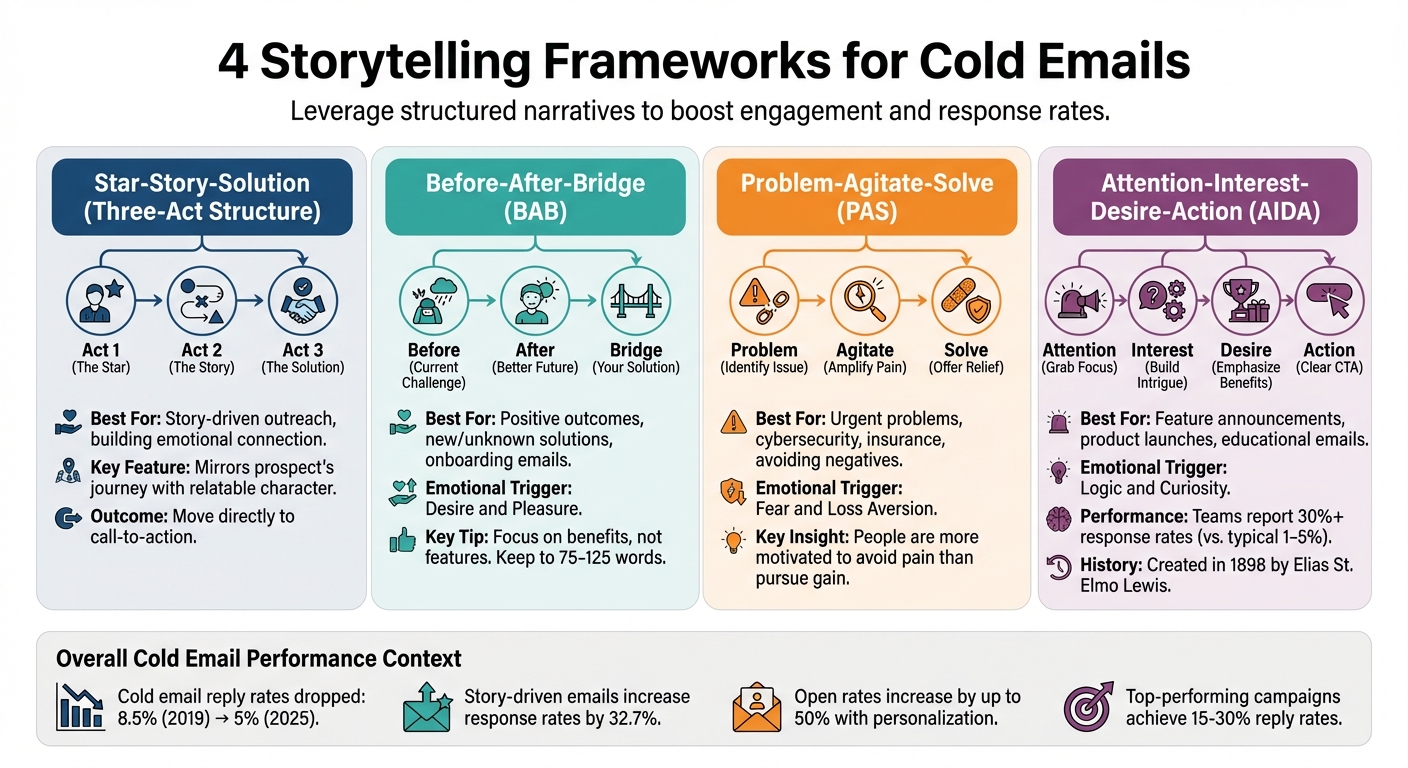
Cold Email Storytelling Frameworks Comparison Guide
Storytelling isn't just for novels or movies - it’s a powerful tool for cold emails too. When done right, it can make your prospect feel engaged before you even ask for anything. Let’s dive into four frameworks that can help you craft compelling email narratives.
The Three-Act Structure
The Three-Act Structure transforms the classic storytelling format into the Star-Story-Solution framework. Sam Greenspan, a cold email copywriter at GMass, describes it as:
"The Star Story Solution formula is likely the most storytelling-driven cold email copywriting strategy you'll ever use."
Here’s how it works:
- Act One (The Star): Introduce a character who mirrors your prospect, facing a relatable problem. Use specific details about their industry or role to create an instant connection.
- Act Two (The Story): Describe their struggle, including failed attempts and common pitfalls. The turning point is an "epiphany" moment where a new solution becomes clear. This builds credibility and emotional investment.
- Act Three (The Solution): Share the happy ending - how the problem was solved. Use data, social proof, or case studies to make the resolution feel tangible. This approach often allows you to move directly to a call-to-action, like scheduling a demo.
If you're looking for a more transformation-focused framework, the next one might be your answer.
Before-After-Bridge (BAB) Framework
The BAB framework is all about transformation. It starts with the prospect's current challenge (Before), paints a picture of a better future (After), and positions your product or service as the way to get there (Bridge).
This approach skips the struggle and goes straight to the positive outcome. As Sam Greenspan explains:
"Before After Bridge copywriting is best when you're presenting a product or service that generates a positive outcome (not something that avoids a negative outcome, like, say, insurance or cybersecurity)."
Key tips for BAB:
- Focus on benefits, not features. For example, instead of mentioning a "database of 8 million keywords", highlight the result: "ranking at the top of Google."
- Keep it concise. Emails that require scrolling on mobile are too long - stick to 75–125 words.
This framework works particularly well for onboarding emails or case study-based outreach. But when urgency is critical, consider the next framework.
Problem-Agitate-Solve (PAS) Framework
PAS takes a different route by focusing on urgency. It identifies a Problem, Agitates it to amplify the pain, and then offers a Solution as relief. Hugo Pochet, Co-Founder at Mailpool, calls it:
"the workhorse of high-converting cold email copywriting. It works because it mirrors how prospects actually think about their challenges."
Here's how it works:
- Problem: Highlight a pressing issue your prospect faces.
- Agitate: Emphasize the consequences of ignoring the problem, triggering an emotional response.
- Solve: Present your product or service as the solution, offering relief and resolution.
This framework taps into loss aversion - the idea that people are more driven to avoid pain than to seek gains. As Sequenzy explains:
"People are more motivated to avoid pain than pursue gain. By surfacing the problem first, you create tension that your solution resolves."
PAS is ideal for addressing urgent, painful challenges, such as those related to cybersecurity or insurance. Its empathetic yet urgent tone makes it a strong choice for cold outreach.
| Framework | Primary Focus | Best For | Emotional Trigger |
|---|---|---|---|
| BAB | Aspirational Transformation | New/unknown solutions, positive gains | Desire and Pleasure |
| PAS | Pain Points & Risk | Urgent problems, avoiding negatives | Fear and Loss Aversion |
| AIDA | Progressive Engagement | Feature announcements, product launches | Logic and Curiosity |
Attention-Interest-Desire-Action (AIDA) Framework
AIDA has been a staple of marketing since 1898, created by advertiser Elias St. Elmo Lewis. As Malay Gupta from GrowLeads notes:
"ranks among the most successful sales frameworks in marketing history."
Here’s how AIDA works:
- Attention: Grab the reader's focus immediately with a personalized subject line or opening sentence that highlights a specific issue. For instance, "I noticed your cart abandonment rate is high" is far more engaging than a generic compliment.
- Interest: Build intrigue by explaining how your solution addresses the problem, offering just enough detail to keep them hooked.
- Desire: Transition from interest to longing by emphasizing benefits, supported by social proof like testimonials or case studies.
- Action: End with a clear, low-barrier call-to-action. Instead of asking for a "30-minute demo", suggest something less intimidating, like a "15-minute chat."
Hugo Pochet sums it up:
"AIDA guides prospects through a logical decision-making journey, addressing objections before they arise."
This framework is best for feature announcements, product launches, or longer educational emails. While cold emails typically see reply rates of 1–5%, teams using AIDA have reported response rates over 30%.
Pattern Interruption and Micro-Stories
Most inboxes are overflowing with generic pitches - think "Hope you're well" or overly polished compliments. These predictable intros are easy to ignore. To stand out, you need to disrupt the usual pattern your prospect's brain expects. This is where pattern interrupts come in. These are psychological triggers that grab attention by breaking the mold, making your message stand out and stick in their memory.
The best places to use pattern interrupts? Your subject line and opening lines. A well-executed pattern interrupt can significantly improve open and response rates. For instance, emails sent at unusual times - like early morning between 6:00 AM and 7:00 AM - see an average 45% response rate because they face less competition. Similarly, quirky subject lines, such as a single unexpected word or something humorous like "I am the walrus!", can cut through the clutter and boost open rates.
But here's the catch: authenticity is key. Tricks like fake "Re:" or "Fwd:" tags might get someone to open your email, but they’ll also get you flagged as spam. The goal isn't to be gimmicky - it's to genuinely stand out.
Writing Subject Lines That Get Opened
Your subject line has one job: get the email opened. Nearly half (47%) of recipients decide whether to open an email based solely on the subject line. The most effective subject lines create a curiosity gap, making readers want to know more. For example, "Noticed this in your checkout flow" teases a specific insight without giving everything away, compelling the recipient to open the email.
Questions work particularly well. They leverage the Zeigarnik effect, where our brains feel compelled to resolve unanswered questions. Emails with question-based subject lines can achieve 5–10% higher open rates than those with statements.
Small tweaks, like using lowercase subject lines, can make your email feel more personal. For example, "hey, quick thing" reads like a casual note from a friend rather than a marketing email. Short, unexpected subject lines - like "Ouch." - can also break the monotony and grab attention.
For mobile users, brevity is crucial. Since mobile devices often cut off subject lines after 25–30 characters, lead with your most compelling element - whether it's personalization, a number, or a curiosity hook. Numbers, in particular, can boost open rates by 45%. For instance, "3 ways [Company] can cut cart abandonment" is far more engaging than a vague alternative.
Here’s a quick guide to what works:
| Psychological Trigger | Why It Works | Example Subject Line |
|---|---|---|
| Curiosity | Sparks intrigue by leaving gaps | Quick idea for {{companyName}} |
| Urgency | Encourages immediate action | Closing this out today |
| Social Proof | Builds trust through examples | How 27 SaaS teams cut bounces |
| Question | Invites a response | {{firstName}}, quick question on hiring? |
When testing subject lines, focus on one variable at a time. For example, compare curiosity-driven lines against ones using social proof to see which resonates with your audience. As the Email Marketing Institute puts it:
"The goal isn't to personalize every element of every email to every prospect. It's to create the impression of personalization where it matters most – starting with the subject line."
Once you’ve nailed the subject line, the next step is keeping their attention with a strong opening.
Using Short Stories in Email Copy
Getting your email opened is just the first step. To keep the reader engaged, your opening lines need to hook them immediately. This is where micro-stories shine. Instead of starting with standard phrases like "I'm reaching out because..." or "I wanted to introduce you to...", lead with a brief, specific story or observation about the prospect.
For example, instead of saying, "We help SaaS companies improve their onboarding", you could write: "Last month, I watched a demo video on your site. I noticed users had to click through five screens before seeing value - and I thought, 'There's got to be a faster way.'" This approach shows you’ve done your homework and understand their challenges .
The secret to an effective micro-story is making it relatable and specific. The "star" of your story should mirror the prospect's struggles, making your solution feel like a natural fit. For instance, if you're emailing a VP of Sales, you might share a quick story about another VP who faced low reply rates but found success through a particular strategy. This not only builds rapport but also makes the recipient feel seen.
Keep it short. B2B decision-makers typically spend just 3 seconds deciding whether to read a cold email, so your micro-story needs to grab attention fast. Put the most compelling part of your story in the first two lines, as these are what mobile users see in preview panes. Avoid generic openers like "Hope you're well" - they waste valuable real estate and make your email blend in with the rest.
Adding visual elements can also serve as powerful pattern interrupts. A personalized screenshot or custom GIF can make your email stand out, as visual content gets 94% more views than plain text. For example, if you're pointing out a website issue, include a screenshot highlighting the problem. This not only grabs attention but also shows you’ve invested time in understanding their situation.
That said, use pattern interrupts sparingly. Overdoing it - especially in every email - can make you come across as unprofessional. Aim to incorporate them in about 20–30% of your initial outreach emails to maintain their impact without overusing the tactic.
How to Implement Storytelling Frameworks
To make your storytelling frameworks work, focus on finding relatable stories, refining your approach through testing, and ensuring your emails actually reach your audience.
Finding Stories That Connect with Prospects
The key to a good story is making it resonate with your audience. Start by aligning your success stories with specific buyer personas and their challenges. Did you know that companies using documented buyer personas are 71% more likely to hit their revenue goals?. That’s a solid reason to take this step seriously.
Use a proven structure for your story: introduce a character (like a founder or client) facing the same problem as your prospect. Show their struggles with ineffective solutions to create an emotional connection, then wrap it up with a happy ending - your product or service solved the issue. As Sam Greenspan from GMass puts it:
"The Star Story Solution method is often at its most effective with a founder-driven product or service telling a first-person story".
Tailor your research time to your target market: spend 15–20 minutes on enterprise leads, 5–8 minutes for mid-market, and rely on automated tools for SMBs. This approach balances effort with expected response rates.
Here’s a real-world example: an SDR at Datadog used LinkedIn posts to create personalized subject lines for prospects. The result? A 54% open rate and an 18% reply rate, crushing their usual 4% baseline.
When crafting your emails, keep them short and to the point - 50–125 words or 6–8 sentences is ideal. Use "you" language frequently. Emails that mention the prospect 6–10 times are more likely to secure meetings. And here’s a promising stat: 91% of B2B buyers are open to engaging with cold emails when they’re relevant and well-written.
Once you’ve identified compelling stories, refine your strategy through targeted testing.
Testing and Improving Your Storytelling
A/B testing is your best friend when it comes to fine-tuning subject lines and calls-to-action (CTAs). Focus on one variable at a time and test with at least 200 prospects per variant. For instance, Chili Piper used the AIDA framework to highlight the importance of "speed-to-lead", boosting response rates from 3% to 12%. Similarly, Gong.io saw their response rate jump from 6% to 14% by using the PAS framework to address sales leaders’ frustrations with forecasting accuracy.
Metrics matter. On average, 80% of B2B deals require at least five touchpoints, but many salespeople give up after just one or two attempts. Build automated email sequences that weave your story across multiple messages instead of relying on a single email.
For CTAs, keep it low-pressure. Instead of asking for a meeting right away, try a softer approach like, "Worth a quick look?" This keeps the conversation going without overwhelming the prospect.
Of course, even the best story won’t work if your email doesn’t land in the inbox. That’s where solid email infrastructure comes into play.
Setting Up Cold Email Infrastructure with Icemail.ai
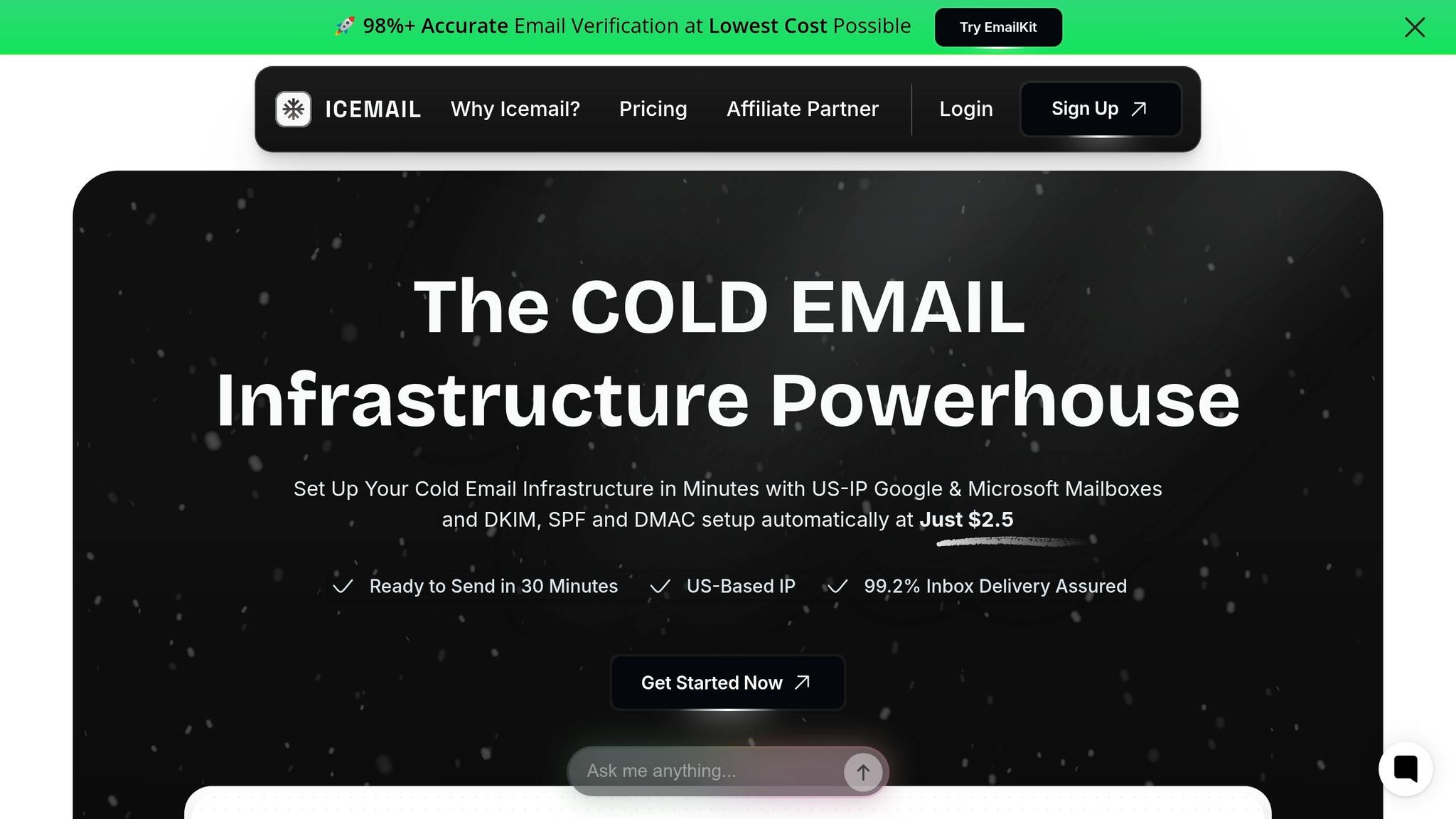
Your story is only effective if it reaches your prospect, which makes reliable email infrastructure non-negotiable. A perfectly crafted email is useless if it ends up in spam.
This is where Icemail.ai shines. It handles the technical setup - SPF, DKIM, and DMARC - automatically, which are critical for inbox placement with providers like Google, Yahoo, and Microsoft. Unlike other platforms requiring manual configuration, Icemail.ai simplifies the process with a 10-minute onboarding and automated domain setup.
The platform also offers bulk mailbox purchases for just $2 per mailbox, supporting both Google Workspace and Microsoft accounts. Need to protect your main domain? Use secondary domains (e.g., "getcompany.com") to safeguard your reputation. For example, Outreach.io moved its cold email operations to a separate domain in 2024, cutting spam rates by 60% and achieving a deliverability rate of 98%. Icemail.ai makes this easy with its bulk purchasing system.
Scalability is another advantage. Sending from multiple mailboxes instead of one reduces the risk of triggering spam filters. Icemail.ai streamlines this with 1-click import/export and automated warmup, building domain trust in just 2–4 weeks.
Consider Meritt’s experience: by using email verification services to clean their lists, they slashed their bounce rate from 35% to under 4%. The result? Their weekly sales pipeline tripled from $100,000 to $300,000. With strong infrastructure in place, you can focus on crafting stories that drive results.
Conclusion
Frameworks like AIDA, PAS, and BAB are designed to guide prospects through an emotional journey, turning hesitation into action. Top-performing cold email campaigns using these frameworks often achieve reply rates of 15–30%, far exceeding the industry average of just 1–5%. While a strong story structure lays the groundwork, even the most compelling narrative is meaningless if it never makes it to the inbox.
As the Prospeo Team aptly states:
"Deliverability is the new copywriting. SPF, DKIM, DMARC, verified emails, and proper warmup matter more than your subject line. A perfectly written email that lands in spam is worth exactly nothing."
Deliverability is crucial - without it, your message will go unread. That’s where Icemail.ai steps in, offering a fast and reliable email infrastructure. With automated SPF, DKIM, and DMARC setup, $2 mailboxes, 10-minute onboarding, and 1-click import/export features, Icemail.ai allows you to scale across multiple domains while safeguarding your sender reputation. This ensures your carefully crafted emails actually reach their intended audience.
When done right, cold email can generate $36 for every $1 spent, combining compelling storytelling with dependable infrastructure. Your chosen framework provides the emotional and psychological structure, your research makes the message personal, and Icemail.ai ensures it lands where it matters most. Pair a storytelling approach that addresses your prospect’s challenges with a robust email system to spark real, meaningful conversations.
FAQs
Which storytelling framework should I use for my cold email?
When it comes to crafting cold emails that get results, using established frameworks can make a huge difference. Approaches like AIDA (Attention-Interest-Desire-Action), PAS (Problem-Agitate-Solution), or Context-Insight-Question are designed to grab attention, address pain points, and encourage the recipient to take action. These methods are all about highlighting challenges, offering useful insights, and motivating the reader to respond.
The key to success? Personalization. Tailor your email to the recipient’s unique circumstances to show you’ve done your homework. Tools like Icemail.ai can help streamline this process by offering fast, premium mailbox setup and automation, ensuring your emails land where they need to - right in the inbox.
How can I write a strong subject line without sounding spammy?
Creating a strong subject line for cold emails is all about clarity, personalization, and relevance. Keep it short and to the point, but don’t shy away from adding a touch of intrigue or urgency to grab attention. Personalization goes beyond just using the recipient's name - mention their company, specific challenges they face, or something relevant to them.
Avoid language that feels overly sales-driven or gimmicky, as it can hurt your credibility. Instead, aim for a tone that feels genuine and professional. Finally, don’t forget to test different subject lines through A/B testing. This can help you figure out what resonates best and boosts your open rates.
How can I improve deliverability so my emails hit the inbox?
To make sure your emails land in inboxes and not spam folders, it's crucial to have the right setup. Start by implementing authentication protocols like SPF, DKIM, and DMARC. These help verify your emails and build trust with email providers. When launching a new domain or IP, take it slow - warm it up over 2-4 weeks by sending fewer than 100 emails daily. This gradual approach helps establish a solid sender reputation.
Always stick to verified contact lists and craft personalized messages to steer clear of spam filters. If you're looking for a reliable solution, Icemail.ai is worth considering. They specialize in fast, premium email infrastructure setup and are known for delivering strong inbox placement results. It's a great choice for scaling your cold email campaigns effectively.