How Scheduling Impacts Cold Email Campaigns
Timing is crucial in cold email campaigns. Learn how to optimize your scheduling for better open and response rates.

Timing is key in cold email campaigns. Research shows that when you send emails can significantly affect open rates, reply rates, and overall engagement. For instance:
- 4–8 AM emails: 42.7% open rate due to minimal inbox competition.
- 6–9 AM emails: 25% higher reply rates, especially from executives.
- Tuesday and Thursday: Best-performing days with open rates from 19% to 27.5%.
Poorly timed emails - like those sent on Mondays or during off-hours - often get ignored, no matter how well-written they are. Scheduling emails during high-engagement windows (like 9 AM–3 PM) can amplify results. Industry-specific habits also matter: C-level executives respond better to early-morning emails, while manufacturing professionals engage more on Tuesday afternoons.
For best results:
- Send emails between Tuesday–Thursday, 8–11 AM or 10 AM–12 PM.
- Use A/B testing to refine timing based on your audience's behavior.
- Align emails with recipients’ local time zones for optimal engagement.
Proper scheduling paired with tools like Icemail.ai can streamline timing, improve deliverability, and maximize campaign outcomes. Start with proven time slots and adjust based on performance metrics like open and reply rates.
Research Data: Scheduling Impact on Campaign Performance
Performance Metrics and Data Trends
Recent research highlights just how much timing can influence email campaign success. Studies examining thousands of campaigns reveal that when you send an email can significantly impact its performance.
For example, emails sent early in the morning - between 4 and 8 AM - achieved an impressive 42.7% open rate, thanks to less competition in inboxes. Meanwhile, mid-morning emails sent between 10 AM and 12 PM saw a 27.9% open rate. Tuesdays and Thursdays consistently lead the pack in terms of weekday performance, with open rates ranging from 19% to 27.5%.
Here’s a snapshot of the data:
| Timing Window | Open Rate | Key Insights |
|---|---|---|
| 4–8 AM | 42.7% | Best performance; minimal inbox competition |
| 10 AM–12 PM | 27.9% | High engagement during mid-morning hours |
| 9 AM–3 PM | 63% (total) | Most opens occur during standard business hours |
| Tuesday/Thursday | 19–27.5% | Top-performing weekdays |
For manufacturing campaigns, Tuesday afternoons stand out even more, achieving an 11.4% open rate and a 25.7% click-through rate, which is a 14% improvement compared to Mondays.
Timing also plays a crucial role in response rates. Emails sent between 6 and 9 AM generate 25% higher reply rates, particularly from C-level executives. While cold email campaigns typically see reply rates between 1% and 8.5%, well-timed and highly targeted emails can achieve reply rates as high as 40–50%. These findings clearly illustrate that timing can make or break a campaign's success.
Timing Impact vs Other Campaign Factors
While timing is critical, it works best when paired with other strong campaign elements. For instance, sending emails at the right time can boost open rates by up to 30% compared to randomly timed messages. However, timing alone isn’t enough - personalization is key. Highly personalized emails sent at optimal times can achieve reply rates of 40–50%, while generic emails sent at poorly chosen times may struggle to exceed 8%.
Timing also influences the effectiveness of subject lines. Personalized subject lines can increase open rates by 50% in cold email campaigns. However, even the most compelling subject line won’t help if your email lands in spam. This is why sender reputation and deliverability are foundational. Without proper domain authentication, clean IP reputations, and DKIM/SPF/DMARC configurations, perfectly timed emails may never reach the intended inbox. Tools like Icemail.ai simplify this process by automating domain authentication and optimizing deliverability for bulk email campaigns.
Follow-up emails also benefit from strategic timing. The first follow-up email can improve reply rates by 49%. Additionally, sending follow-ups three days after the initial email and maintaining consistent scheduling can increase overall response rates by up to 65.8%.
The research underscores a clear hierarchy for campaign success: strong deliverability ensures emails reach inboxes, personalization drives engagement, and optimal timing enhances that engagement. Companies that excel in all three areas see the best results, while focusing on just one leads to only limited improvements.
I Studied 1,000,000 Cold Emails, Here’s What Works in 2025
Best Scheduling Practices for Cold Emails
Drawing from research data, these scheduling tips can help fine-tune your cold email campaigns for better results.
Top Days and Times for Email Delivery
When it comes to cold email success, Tuesday through Thursday are your best bets. These midweek days consistently outperform Mondays and Fridays. For instance, Tuesday boasts a 27.5% open rate, with Thursday close behind at 26%.
Why? Tuesday gives recipients time to clear out their weekend backlog, while Thursday benefits from pre-weekend focus and planning.
As for timing, early mornings between 8-11 AM perform exceptionally well. This period aligns with when professionals typically check their inboxes before diving into meetings or deep work. Another strong window is 10 AM to 12 PM, which achieves a 27.9% open rate, as it catches people during their mid-morning productivity peak.
Here’s a quick breakdown of the best email delivery windows:
| Time Window | Open Rate | Why It Works |
|---|---|---|
| 8-10 AM | 27.5% | Pre-meeting email check |
| 10 AM-12 PM | 27.9% | Mid-morning productivity peak |
Avoid Mondays - they’re chaotic with weekend catch-up - and Fridays, when attention shifts to weekend activities. Weekends may work only for niche industries where decision-makers check emails during personal time.
Next, let’s see how these trends vary across industries.
Industry-Specific Timing Differences
Not every industry follows the same email habits. For example, tech executives and C-level professionals respond best to emails sent early in the morning, between 6-9 AM. These decision-makers often start their day earlier, handling important communications before their schedules fill up.
On the other hand, manufacturing professionals engage most with emails sent on Tuesday afternoons. One study revealed an 11.4% open rate and 25.7% click-through rate during this period - a 14% increase compared to Monday sends. This aligns with their operational workflows and decision-making rhythms.
For B2B sectors, the Tuesday-Thursday, 9 AM to 3 PM rule generally holds true. However, B2C and event-driven industries often break from this pattern. For example, hospitality and events companies see stronger engagement over weekends, as consumers plan leisure activities during their personal time.
The takeaway? Understand your audience’s work habits. A tech CEO checking emails at 6 AM has a very different routine than a manufacturing manager reviewing messages during afternoon breaks.
These nuances highlight the importance of ongoing experimentation.
A/B Testing Your Email Timing
Even with all this research, your audience may behave differently. That’s why A/B testing is critical for identifying your optimal send times. This involves sending identical emails to different groups at varying times and analyzing engagement metrics.
Start with 200 recipients per test group to ensure statistically meaningful results. Run tests over a full business week to account for day-of-week variations. Focus on metrics like open rates, click-through rates, and reply rates, rather than just opens.
Many email platforms now automate A/B testing, but the concept remains the same. For example, compare Tuesday at 9 AM to Thursday at 11 AM or 8 AM to 12 PM. Track results over at least two weeks before drawing conclusions.
A great example comes from a B2B tech company in 2023. By shifting from Monday morning sends to mid-morning deliveries on Tuesday through Thursday, they boosted their cold email open rate by 30%. Adjusting for local business hours across their global audience further enhanced their results.
The formula is simple: start with proven windows like Tuesday-Thursday, 8-11 AM, and then refine based on your audience’s actual behavior. Through consistent testing, you’ll uncover clear patterns, allowing you to maximize your campaign’s impact while ensuring reliable deliverability.
Email Frequency and Audience Targeting for Scheduling
Getting your email frequency right is just as important as choosing the right time to send. Bombarding your audience with too many emails can push them away, while sending too few might mean missed opportunities. The goal is to strike a balance where your emails stay relevant without becoming a nuisance.
Finding the Right Email Frequency
Studies suggest that sending 2–3 follow-up emails spaced 3–4 days apart tends to yield the best engagement. Campaigns with 4–7 emails in total often see better response rates compared to those with only 1–3 emails. However, going beyond 3–4 emails in a sequence can lead to diminishing returns and increase the risk of your messages being flagged as spam.
Here’s a simple approach: start with an initial email, follow up a week later, and then space additional follow-ups every 3–4 days. This cadence keeps you on their radar without overwhelming them.
Once your frequency is set, the next step is to align your timing with your audience’s habits.
Scheduling by Time Zone and User Behavior
When dealing with a global audience, timing can make or break your campaign. Sending emails to land in your recipient’s inbox during their local business hours can significantly boost engagement. To handle varying time zones, many email platforms offer features to automatically adjust send times based on the recipient's location.
Different professions also have unique email engagement patterns. Here’s a quick breakdown:
| Audience Segment | Optimal Send Time | Why It Works |
|---|---|---|
| C-level Executives | Early morning (5–9 AM) | They often check emails before their meetings. |
| Manufacturing Professionals | Mid-afternoon | Fits better with their operational workflows. |
| Tech Executives | Early mornings (6–9 AM) | Many start their workday earlier than others. |
Additionally, smaller, more targeted campaigns often outperform mass emails sent to large, broad audiences. By combining precise scheduling with a thoughtful email cadence, you can maximize your chances of success.
Adjusting Schedules Based on Performance Data
Once your campaign is live, use performance metrics to refine your schedule. If emails sent at specific times - say, Tuesdays at 10 AM - consistently outperform others, make that your go-to window for future campaigns.
Key metrics to monitor include:
- Open rates: Measure if your timing aligns with when recipients check their inbox.
- Response rates: Gauge genuine engagement beyond just opening the email.
- Spam complaint rates: Signal if you’re over-emailing or targeting poorly.
- Click-through rates: Show when recipients are motivated to take action.
To fine-tune your approach, run A/B tests over a business week and track results for at least two weeks. A good starting point is to schedule emails between Tuesday and Thursday, 9 AM–2 PM, in your audience’s local time. Then, adjust based on what the data reveals.
Keep in mind that engagement patterns evolve due to industry trends, seasonal changes, or shifts in work habits. Regularly revisiting and tweaking your scheduling strategy ensures you stay in sync with your audience’s preferences.
Email Automation Tools for Scheduling
When it comes to cold email campaigns, timing is everything. But even the best scheduling strategies can fall flat without the right tools to back them up. Choosing the right email automation platform can make all the difference, helping you hit the perfect timing while ensuring your campaigns run smoothly. With so many options out there, finding the right fit requires a close look at factors like setup time, deliverability rates, and scheduling flexibility.
Platform Comparison: Scheduling Capabilities
The email automation market is full of options, but not all platforms are created equal. Some focus on affordability with basic features, while others offer premium services with advanced tools and faster onboarding. How do they stack up?
Budget-friendly platforms often require manual DNS configuration, which can slow things down. For example, Lemlist typically takes 5–7 days to set up and has deliverability rates that hover below 85%. On the other hand, mid-tier options like Smartlead.ai and Growleady improve on scheduling features but still take some time to set up - Smartlead.ai usually takes 2–3 days, while Growleady can be up and running in 1–2 days.
Premium platforms, however, prioritize speed and reliability. Faster setup and higher deliverability rates make them stand out. Let’s take a closer look at how some of the leading platforms compare in key areas:
| Feature | Icemail.ai | Smartlead.ai | Growleady | Lemlist |
|---|---|---|---|---|
| Setup Time | 10 minutes | 2–3 days | 1–2 days | 5–7 days |
| Inbox Delivery Rate | 99.2% | 87–92% | 85–90% | 80–85% |
| Automated DNS Setup | Yes (SPF, DKIM, DMARC) | Manual | Manual | Manual |
| Cost per Mailbox | $2.50/month | $5.00/month | $4.50/month | $6.00/month |
| Pre-warmed Mailboxes | Available ($5/month) | Not offered | Not offered | Not offered |
| Free Replacements | Unlimited | Charges apply | Charges apply | Charges apply |
Scaling your campaigns can also reveal big cost differences. For example, managing 20 mailboxes with Icemail.ai costs just $50/month, compared to $100/month for Smartlead.ai or $120/month for Lemlist.
Icemail.ai: Premium Cold Email Scheduling Solution
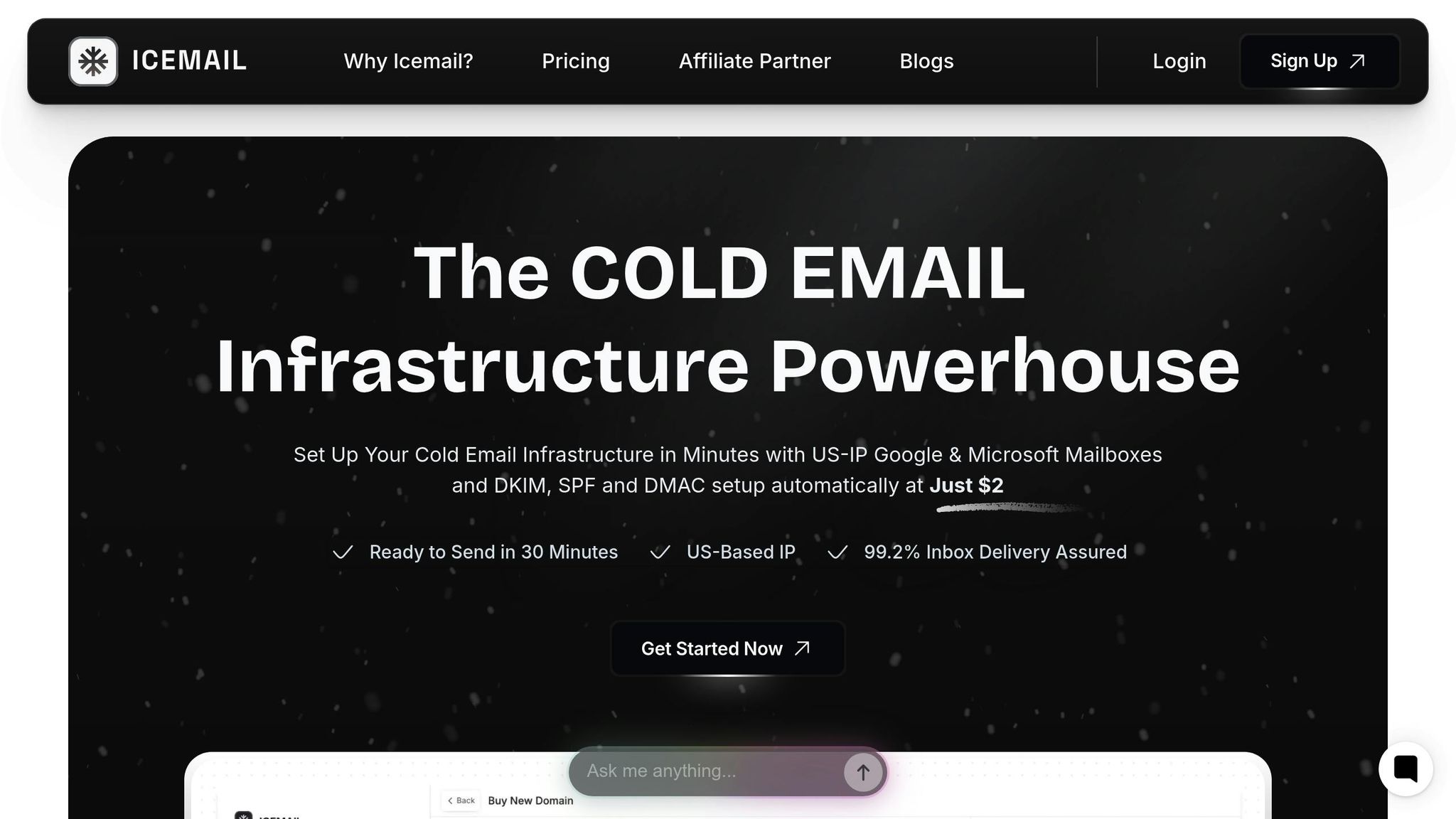
If you’re looking for speed, reliability, and ease of use, Icemail.ai stands out as an excellent choice for US-based businesses. Its 10-minute onboarding process eliminates the lengthy setup times associated with many other platforms, allowing you to launch campaigns almost immediately.
Users have praised the platform for its efficiency. Suprava Sabat from AcquisitionX shared:
"Icemail.ai has transformed how I manage my email infrastructure. The automated setup for Google Workspace accounts, including DKIM, SPF, and DMARC configuration, saved me hours of work."
What really sets Icemail.ai apart is its official partnerships with Google and Microsoft, which bolster its infrastructure. These partnerships allow it to offer US-based IP mailboxes at just $2.50/month for Google Admin accounts and $3/month for Microsoft mailboxes. With pre-warmed mailboxes and automated DNS setup, the platform achieves an impressive 99.2% inbox delivery rate.
For businesses juggling multiple campaigns, Icemail.ai’s unified inbox simplifies response management by consolidating all replies into one dashboard. And if a mailbox gets flagged or banned? No problem - unlimited free replacements ensure your campaigns keep running without additional costs.
Another standout feature is its flexible pricing model. You only pay when you use the platform, making it easy to scale without committing to long-term subscriptions. For companies that need to get campaigns off the ground quickly, Icemail.ai’s promise of being “ready to send in 30 minutes” gives it a clear edge over competitors that require days - or even weeks - to set up.
Technical Setup: Infrastructure for Scheduled Email Campaigns
Getting your email campaigns to run smoothly and hit inboxes at the right time starts with having the right technical setup. For large-scale cold email campaigns, this foundation is critical. Even with perfect timing, poorly configured systems can mean your emails never get seen. Here’s how to ensure your infrastructure is up to the task.
Required Infrastructure for Bulk Email Campaigns
At the heart of any successful cold email campaign are authentication protocols. These protocols - DKIM, SPF, and DMARC - are essential for reducing spam folder placements and bounce rates.
- DKIM (DomainKeys Identified Mail) adds a digital signature to your emails, confirming their authenticity.
- SPF (Sender Policy Framework) specifies which servers are authorized to send emails on behalf of your domain, protecting against spoofing.
- DMARC (Domain-based Message Authentication, Reporting & Conformance) ties everything together, instructing recipient servers on how to handle emails that fail authentication checks.
For instance, a B2B software company that automated its DKIM, SPF, and DMARC setup saw its open rates jump from 18% to 32%, while response rates doubled. This improvement was directly linked to fewer emails landing in spam folders and reduced bounce rates.
Another key component is DNS management. Your DNS records need to be monitored and updated regularly. A single misconfiguration can hurt your deliverability overnight, while a well-maintained DNS ensures your authentication protocols function as intended.
For campaigns targeting US audiences, using US-based IP addresses via providers like Google Workspace or Microsoft mailboxes can improve inbox placement rates. These providers already have strong reputations with major email services, giving your campaigns an edge right from the start.
As your campaigns grow, scalable mailbox management becomes crucial. Manually managing hundreds of mailboxes can lead to errors and slowdowns. Automated systems that handle mailbox creation, warm-up processes, and management across domains can save time and reduce risks.
New mailboxes often face scrutiny from spam filters. That’s why pre-warmed mailboxes - which already have a positive sending reputation - are so effective. They allow you to start sending at full capacity immediately, without waiting weeks for gradual warm-up periods.
Icemail.ai's Infrastructure Setup Advantages
Icemail.ai takes all the complexities of technical setup and automates them, saving you time and effort. While many platforms require days or even weeks of manual configuration, Icemail.ai gets everything done in just 10 minutes, with campaigns ready to launch in 30 minutes.
The platform handles all critical components automatically, including DKIM, DMARC, and SPF configurations for each domain and mailbox. It also offers an easy-to-use interface for managing DNS records, eliminating the need for technical expertise. This streamlined process avoids the common mistakes that often come with manual setups.
Icemail.ai’s partnerships with Google and Microsoft provide additional advantages. These relationships give users access to premium IP addresses and advanced deliverability features, contributing to the platform’s impressive 99.2% inbox delivery rate.
Scaling is effortless with Icemail.ai. You can purchase multiple mailboxes in bulk, with AI-powered autofill completing the setup. Automated DNS configuration ensures everything is ready to go without delays.
To address one of the most common challenges - mailboxes being flagged or banned - the platform offers unlimited free mailbox replacements. Unlike other providers that charge replacement fees, Icemail.ai absorbs these costs, keeping your campaigns running without unexpected expenses.
The platform is also cost-effective. Google Admin mailboxes are available for just $2.50/month, while Microsoft mailboxes cost $3/month. Pre-warmed mailboxes, priced at $5/month, let you bypass the typical warm-up period and start sending immediately.
Managing responses across large campaigns is simplified with the unified inbox feature. All replies from your mailboxes are consolidated into a single dashboard, ensuring you never miss an opportunity. This is particularly useful when handling dozens of mailboxes across multiple domains.
For agencies juggling multiple clients, Icemail.ai offers separate workspace accounts. Each client’s infrastructure is isolated, ensuring data security while still benefiting from the same automated tools. This setup also makes billing and reporting much easier to manage.
Conclusion: Main Points for Cold Email Scheduling
Research highlights that timing plays a crucial role in cold email success. Sending emails between Tuesday and Thursday, specifically from 9:00 AM to 2:00 PM, can increase open rates by up to 30% and reply rates by up to 25%. For executives, early morning emails - between 6:00 AM and 9:00 AM - tend to perform better.
However, timing alone isn’t enough. Success also depends on tailoring your strategy to specific industries. For instance, manufacturing professionals are more responsive to emails sent on Tuesday afternoons, while tech executives tend to engage more with early morning outreach. Understanding and adapting to these industry-specific behaviors can make a noticeable difference in your results.
Consistency is another critical factor. Sticking to a regular schedule helps reduce the risk of unsubscribes or spam flags. This underscores the importance of continuously testing your approach to ensure it aligns with your audience’s preferences.
A/B testing remains an essential method for refining your campaigns. By experimenting with different send times, subject lines, and email frequencies - and closely monitoring metrics like open, click-through, and reply rates - you can fine-tune your strategy to better connect with your audience.
Of course, even the best timing won’t matter if your emails don’t reach the inbox. That’s where reliable technical support comes in. Tools like Icemail.ai simplify the process with a quick 10-minute setup and an impressive 99.2% inbox delivery rate. Their affordable options - Google Admin mailboxes at $2.50/month and Microsoft mailboxes at $3.00/month - include unlimited free mailbox replacements, ensuring your focus stays on campaign optimization, not technical issues.
To succeed, SDRs and marketers should aim for a comprehensive approach: schedule emails midweek during business hours, segment audiences by time zone and industry, and rely on automation tools to handle technical challenges. When data-driven scheduling meets dependable infrastructure, cold email campaigns are positioned to deliver consistent and impactful results.
FAQs
What’s the best time to send cold emails for higher open and response rates?
The ideal time to send cold emails can vary based on your industry, audience, and their daily habits. However, research suggests that midweek - especially Tuesdays and Wednesdays - often sees higher open and response rates. Timing during the day is just as crucial. Emails sent in the morning, typically between 8 and 10 a.m., tend to perform well since many people start their day by checking their inbox.
To fine-tune your approach, dive into your previous campaign data or experiment with A/B testing to pinpoint when your audience engages most. Tools like Icemail.ai make this easier by providing advanced features like managing multiple mailboxes and improving email deliverability. These capabilities can give you an edge in reaching your prospects more efficiently.
How does scheduling and personalization influence the success of a cold email campaign?
Scheduling and personalization play a key role in the success of any cold email campaign. Sending emails at the right moment can greatly boost open rates and response rates by ensuring your message lands in front of recipients when they’re most likely to take notice. Studies suggest that aligning your emails with your audience's time zone and typical work hours can make a noticeable impact.
Personalization adds another layer of effectiveness. By customizing subject lines, greetings, and content to address the recipient’s specific interests or challenges, you can make your emails more engaging and increase the chances of getting a reply. For businesses aiming to simplify this process, tools like Icemail.ai provide advanced services to enhance email deliverability and streamline campaign management, helping you achieve better results with less hassle.
How does Icemail.ai improve cold email campaign performance and deliverability compared to other platforms?
Icemail.ai takes the hassle out of cold email campaigns by focusing on high deliverability rates. It automates DNS setup, including SPF, DKIM, and DMARC configurations, ensuring your emails land in inboxes - not spam folders.
One standout feature is its lightning-fast onboarding process, which gets you up and running in just 10 minutes. Plus, with AI-driven domain suggestions and unlimited free mailbox replacements, Icemail.ai offers a reliable and efficient solution for cold email outreach. Compared to competitors, it boasts better reviews and quicker setup times, making it a top choice for scalable and professional email campaigns.