Best Practices for Automating Prospect Lists
Automating prospect lists with ICPs, persona scoring, verified enrichment, CRM sync, and private email infrastructure to improve deliverability and conversion.


Automating prospect lists can save you time, improve accuracy, and increase sales efficiency. Here's why automation matters and how to do it right:
- Time Savings: Sales reps spend 6+ hours weekly on manual research. Automation reduces this significantly.
- Data Decay: B2B contact data decays at 25–35% annually. Automation ensures your lists stay updated.
- Higher Conversion Rates: Automated, signal-driven lists achieve 3–8% meeting rates compared to 1–3% with manual lists.
- Scalability: Managing outreach for deals involving 11–13 stakeholders becomes feasible with automation.
Key Steps:
- Define Your ICP (Ideal Customer Profile): Identify top customers and their attributes (industry, size, revenue). Use scoring models to prioritize high-potential leads.
- Refine Buyer Personas: Focus on decision-makers and personalize outreach based on their roles and pain points.
- Choose the Right Tools: Use platforms like LinkedIn Sales Navigator, Apollo.io, or Cleanlist for sourcing and enriching data.
- Ensure Compliance: Follow GDPR, CAN-SPAM, and CASL regulations to avoid penalties and maintain sender reputation.
- Monitor and Update: Regularly clean your lists and track signals like job changes or funding announcements to target active buyers.
Quick Comparison of Tools:
| Tool | Best For | Key Feature | Starting Price |
|---|---|---|---|
| LinkedIn Sales Navigator | Advanced Filtering | 40+ professional search filters | $99.99/month |
| Apollo.io | All-in-one Platform | 275M+ contact database, integrated sequencer | $49/month |
| Cleanlist | AI-Powered List Building | Waterfall enrichment (15+ sources) | Free tier |
| Icemail.ai | Email Infrastructure | Automatic DKIM, DMARC, SPF setup | $2/mailbox |
Automation transforms prospecting into a scalable, data-driven process. Focus on verified, signal-driven lists, compliance, and the right tools to boost results.
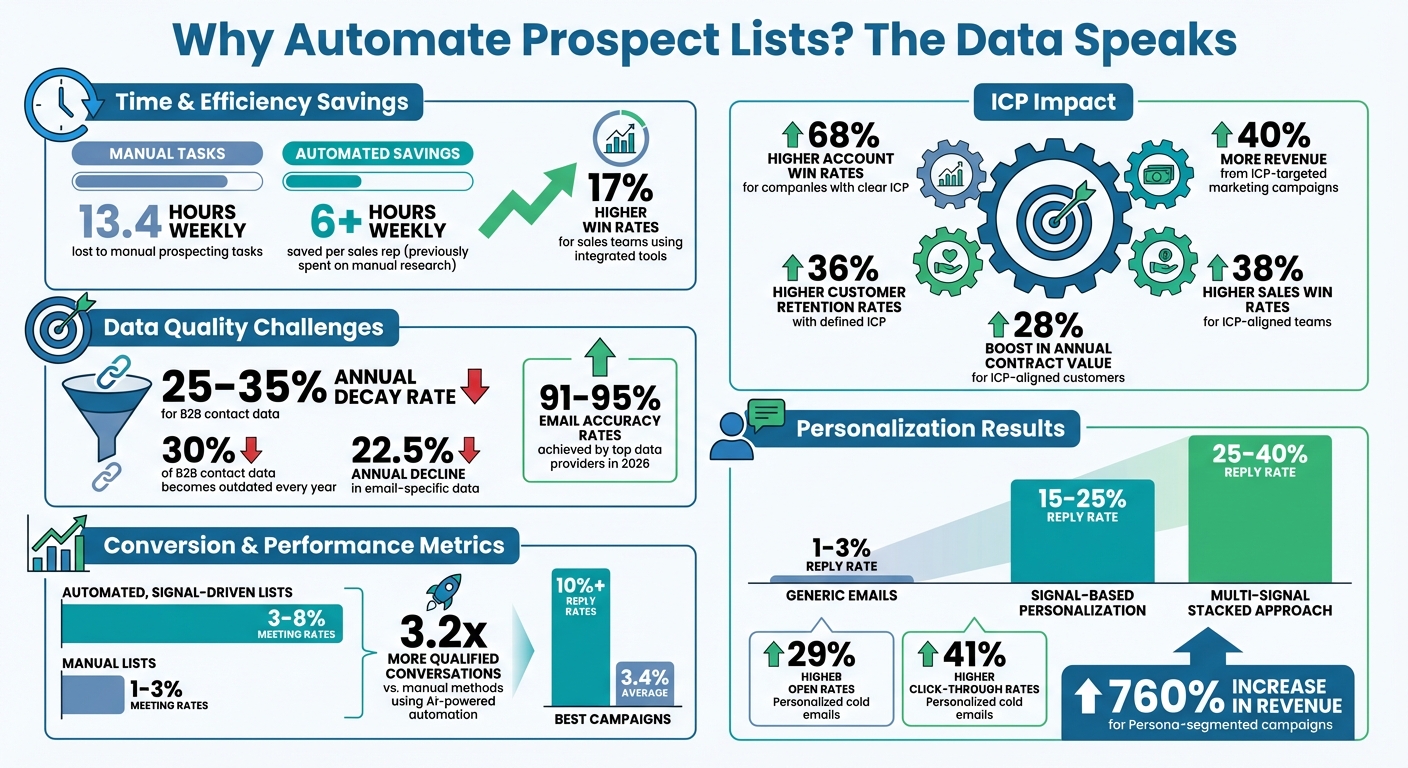
Prospect List Automation: Key Statistics and ROI Metrics
Creating a Killer Prospect List that Matches Your Exact Target Audience | The Laser Beam Approach
Define Your Ideal Prospect Profile
The real magic of automation kicks in when it’s guided by a well-defined Ideal Customer Profile (ICP). Without one, your automation tools might churn out lists of irrelevant contacts, wasting time and resources. Companies with a clear ICP see 68% higher account win rates and 36% higher customer retention rates. In short, a solid ICP turns automation into a precision tool for closing deals.
An ICP focuses on the companies you aim to sell to, using attributes like industry, revenue, and company size. On the other hand, buyer personas zero in on the people within those companies - like a VP of Sales struggling to hit quotas or a CTO wrestling with integration issues.
"Your ICP tells you which building to walk into. Your buyer personas tell you which offices to visit and what to say to each person when you get there."
This insight from Mamta Tainwala of Strategy & Trends underscores the importance of using both ICPs and personas to guide automation efforts.
Getting your ICP right isn’t just theoretical - it directly impacts results. Teams aligned around an ICP enjoy 38% higher sales win rates, while marketing campaigns targeting an ICP generate 40% more revenue. Plus, selling to ICP-aligned customers boosts annual contract value by 28% compared to non-ICP customers. These stats highlight why ICPs are essential for maximizing automated prospecting.
How to Build an Ideal Customer Profile (ICP)
Start by analyzing your top 20% of high-value customers. Look for patterns in their industry, size, revenue, and technology stack. These patterns will help you shape your ICP.
Your ICP should include five key components:
- Firmographics: Details like industry, company size, revenue, and location.
- Technographics: Their current tech stack and how it aligns with your solution.
- Pain Points and Buying Triggers: Specific challenges (e.g., long ramp-up times for sales reps) or events (e.g., recent funding rounds).
- Buying Process: The decision-making structure, which often involves four or more stakeholders in B2B deals.
- Success Indicators: Metrics like a target annual contract value or a healthy LTV:CAC ratio (aim for at least 3:1).
It’s also important to define your "anti-ICP" - the types of companies you want to avoid. This might include industries with high churn, businesses lacking the necessary infrastructure, or companies below a certain revenue threshold. This step ensures your automation tools don’t waste resources on leads that won’t convert.
Once your ICP is outlined, convert it into a scoring model for your automation tools. Assign points to each ICP element - for instance, 20 points for an industry match, 15 points for tech stack compatibility, and 10 points for indicators like recent funding. Focus your outreach on prospects scoring 70+ out of 100 to target "Tier 1" leads with the highest potential.
| ICP Element | Automation Application | Example Filter |
|---|---|---|
| Firmographics | List Segmentation | Industry: FinTech; Size: 50-200 employees |
| Technographics | Compatibility Filtering | Uses: HubSpot, Salesforce |
| Buying Triggers | Timing & Urgency | Recently raised Series A funding |
| Disqualifiers | Automatic Exclusion | No dedicated sales leadership |
Treat your ICP as a living document. Revisit it quarterly to make adjustments based on win/loss data and evolving market conditions. If you’re just starting out, use your top 10 customers as a starting point. Test this profile with smaller campaigns before scaling up.
Use Buyer Personas for Better Targeting
While your ICP helps you identify the right companies, buyer personas refine your focus to the right individuals. In complex B2B sales, where decisions often involve five or more stakeholders, personas ensure you’re targeting the right roles - like the User (who owns the problem), the Champion (your internal advocate), and the Economic Buyer (who controls the budget).
Personas also enable more personalized messaging. Campaigns segmented by persona can deliver impressive results, such as a 760% increase in revenue, while personalized cold emails see 29% higher open rates and 41% higher click-through rates compared to generic ones.
Take the example of Zeliq, a sales platform that, in July 2023, helped a SaaS company boost its cold email reply rate from 2.1% to 8.7% within 30 days. The key? Segmenting outreach by job title and industry while tailoring content to address specific pain points for each persona group. This case study highlights the power of combining ICP-level targeting with persona-level messaging.
To optimize automation, implement dual-level scoring. Score prospects at both the account level (ICP fit) and the contact level (persona fit). A great contact at a poor-fit company should still be deprioritized. Start with 2-3 core personas based on job roles and industries, gathering performance data before expanding to more detailed sub-segments. Enhance your targeting further by incorporating intent triggers like new leadership hires or recent funding announcements to time your outreach when urgency is highest.
Select the Right Automation Tools
Once you've fine-tuned your ICP and buyer personas, the next step is choosing the right tools to bring your strategy to life. Not all tools are created equal - differences in data accuracy, update frequency, and compatibility with your current systems can significantly impact results.
For instance, legacy platforms like ZoomInfo and Apollo boast extensive databases with millions of contacts. However, their accuracy can range from 32% to 69%, largely due to slower update cycles. On the other hand, real-time tools like PhantomBuster and Cleanlist extract up-to-date data directly from LinkedIn profiles and company websites, achieving accuracy rates between 60% and 95%. A 2026 benchmark test highlighted Cleanlist's capabilities: it generated a verified list of 100 US SaaS VPs in just 60 seconds, with 98% email verification and 85% phone coverage. By comparison, Apollo took 4 minutes (75% email accuracy), and ZoomInfo took 6 minutes (88% email accuracy).
For filling in missing data, waterfall enrichment is a game-changer. This method pulls from over 15 data providers to ensure gaps are filled - if one source lacks a phone number or has outdated emails, another steps in, boosting email verification rates to as high as 98%.
Smooth CRM integration is equally important. Tools that sync bidirectionally with platforms like Salesforce, HubSpot, and Pipedrive ensure all interactions - emails, calls, meetings - are automatically logged. Smaller teams may prefer tools with built-in functionality, while enterprise teams should prioritize those that support more complex workflows.
Top Tools for Lead Data Sourcing
Here’s a closer look at some standout tools for sourcing and enriching high-quality prospect data:
- LinkedIn Sales Navigator: Known for its advanced filtering capabilities, it offers over 40 filters to refine searches by job title, seniority, company size, and more. Plans start at $99.99/month.
- PhantomBuster: This tool automates data extraction from LinkedIn profiles, posts, and events. Starting at $56/month, it provides 20 hours of execution time and 10,000 AI credits - a cost-effective way to pull live data.
- Apollo.io: With its 275M+ B2B contact database and integrated outreach sequencer, Apollo is an all-in-one solution. While its free plan is attractive for startups, paid plans start at $49/month. However, pairing it with a verification tool or waterfall enrichment is recommended, as its email accuracy hovers around 70–80%.
- Cleanlist: Perfect for AI-driven list building, Cleanlist allows users to describe their ICP in plain text, generating verified lists swiftly. It even offers a free tier and ranked first for speed and accuracy in 2026 benchmark tests.
| Tool | Best For | Key Feature | Starting Price |
|---|---|---|---|
| LinkedIn Sales Navigator | Advanced Filtering | 40+ professional search filters | $99.99/mo |
| PhantomBuster | Real-time Extraction | LinkedIn profile scraper | $56/mo |
| Apollo.io | All-in-one Platform | 275M+ contact database, integrated sequencer | $49/mo (Free plan available) |
| Cleanlist | AI-Powered List Building | Waterfall enrichment (15+ sources) | Free tier |
Enrich Prospects with Verified Data
Even the most meticulously sourced lists require enrichment to fill in missing details like phone numbers, job titles, and firmographic data. Here are some top options:
- Cognism: Ideal for targeting European markets while staying GDPR-compliant. Its "Diamond Data" feature provides phone-verified mobile numbers - essential for cold calling. Pricing ranges from $15,000 to $103,000 annually.
- Clay: This tool shines for teams that prioritize accuracy, offering integration with over 100 data sources. Plans start at $134/month.
- Lusha: A budget-friendly option at $36/month, Lusha includes a browser extension for quick lookups. However, its reliance on a single data source makes it better suited for smaller teams or simpler needs.
To maintain sender reputation, triple email verification is critical. Without proper optimization, 91% of cold outreach emails fail to get a response.
Why Icemail.ai is the Best Option for Outreach
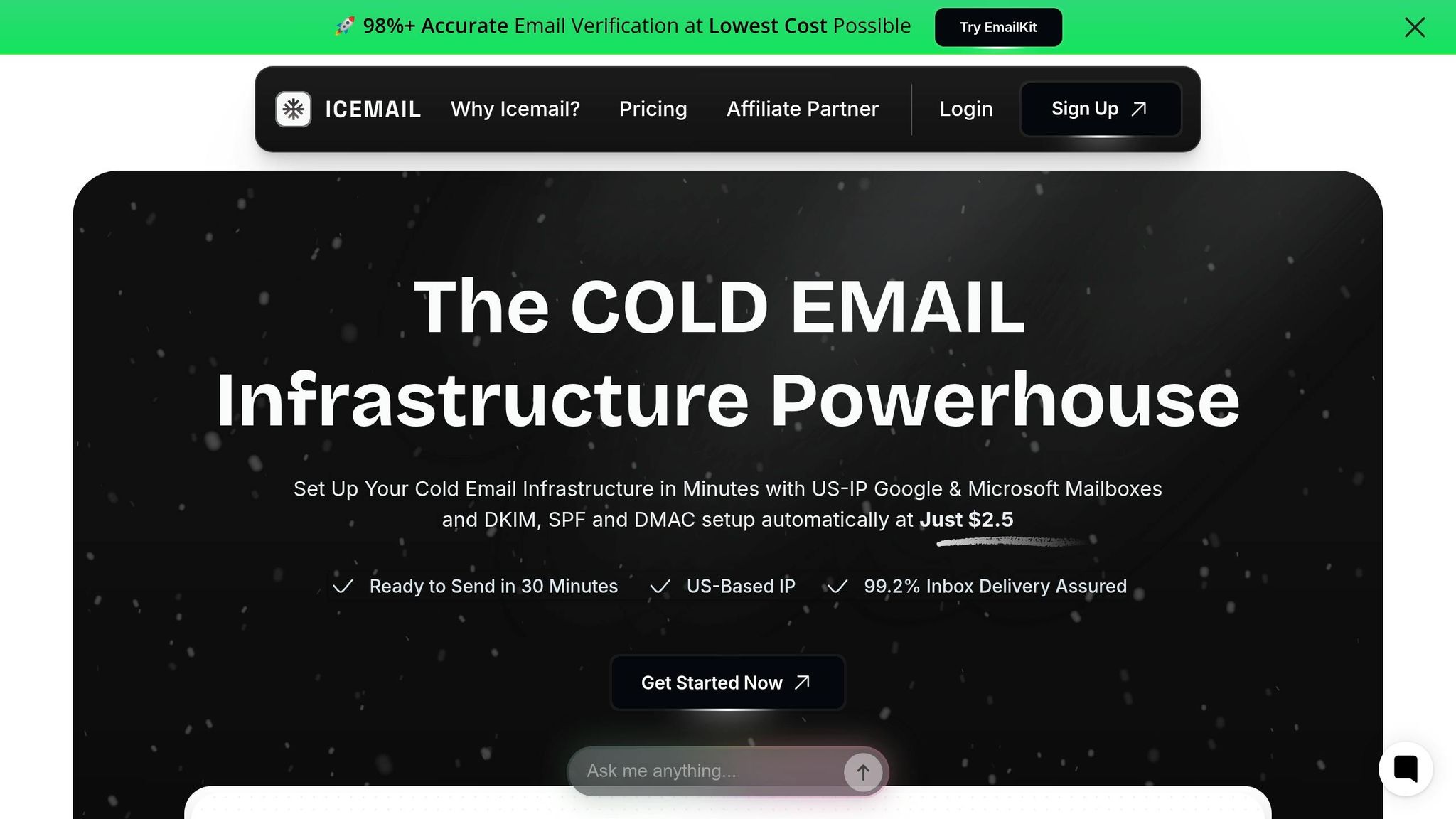
While sourcing and enriching tools are essential for building a strong prospect list, having the right email infrastructure is just as important. That's where Icemail.ai excels. Unlike other platforms that try to handle every aspect of sales, Icemail.ai focuses solely on optimizing email infrastructure. This specialization ensures higher deliverability rates for high-volume outreach campaigns.
One of its standout features is its quick onboarding process. In just 10 minutes, users can purchase Google Workspace or Microsoft mailboxes for $2 each, with automatic setup for DKIM, DMARC, and SPF - saving hours of manual work. Competitors like Instantly.ai and Reply.io require more hands-on setup, making Icemail.ai a faster and more efficient solution.
Scaling is also seamless with Icemail.ai. Features like one-click mailbox export and bulk updates allow teams to grow from 10 to 100 mailboxes in minutes, not days.
| Feature | Icemail.ai | Instantly.ai | Reply.io | Outreach.io |
|---|---|---|---|---|
| Primary Focus | Email Infrastructure | High-volume Campaigns | Multichannel Outreach | Enterprise Sales |
| Pricing Indicator | $2 per mailbox* | Starting at $37/month | - | - |
*Pricing based on promotional information.
Integrate Automation with CRM and Outreach Platforms
Connecting your CRM with outreach tools can supercharge your automation efforts. Think of your CRM as the central hub for customer data, while your outreach platform handles high-volume campaigns.
"Your CRM is the system of record for customer relationships. Instantly is the system of action for cold outreach." – Hans Dekker, Instantly
To keep things organized, use a dedicated outreach platform for cold campaigns and sync only qualified leads to your CRM. This strategy not only safeguards your primary domain from risks but also keeps your CRM free of unqualified contacts. The result? A cleaner database and more effective outreach efforts.
Data accuracy plays a huge role here. B2B contact data becomes outdated quickly - often within a year. Using real-time validation gates to catch invalid email addresses before they enter your CRM can help maintain bounce rates below 1%.
CRM Integration Best Practices
For smooth operations, enable a two-way sync between your CRM and outreach tools. Tools like OutboundSync (starting at $99/month) can log every email, reply, and meeting in both systems.
Before syncing, set up custom CRM properties like "Signal Source", "ICP Score", or "Verification Date" to add context to your records. Use email addresses as the key for contact records and domain names for companies. This "upsert" logic ensures updates to existing records instead of creating duplicates.
Set specific sync rules for different data types. For static fields like job titles or company size, use "Fill If Empty" to avoid overwriting manual updates. For dynamic fields like engagement scores, use "Always Update". These practices help scale your prospecting efforts without sacrificing data quality. In fact, sales teams using well-integrated tools report a 17% higher win rate and close deals that are 42% larger on average.
Test your sync with a small batch of 10–50 records to confirm field mappings. Standardize data formats upfront - unify job titles (e.g., "V.P." to "VP") and use ISO 3166 country codes to ensure proper segmentation. Poor data quality can cost businesses an average of $12.9 million annually, so taking the time to set up your system correctly is worth it.
Simplify Email Campaigns with Automation
Accurate CRM data is the foundation of scalable email campaigns. Once your CRM sync is solid, focus on optimizing your email infrastructure for efficiency.
This is where Icemail.ai shines. Unlike platforms like Instantly.ai and Reply.io, which often require manual DNS and domain authentication setup, Icemail.ai automates the entire process in just 10 minutes.
For just $2 per mailbox, Icemail.ai provides Google Workspace or Microsoft accounts with automatic DKIM, DMARC, and SPF configurations - saving you hours of technical work. Scaling your outreach? Icemail.ai's one-click export and bulk update features make it easy to grow from 10 to 100 mailboxes in minutes.
Users consistently praise Icemail.ai for its faster inbox setup times compared to competitors. For teams running large-scale cold outreach campaigns, reliable, plug-and-play infrastructure means you can spend more time on strategy and personalization instead of troubleshooting. With Icemail.ai, you can create an automation workflow that ensures data accuracy and maximizes deliverability.
Maintain Data Compliance and List Hygiene
Keeping your prospect lists clean is essential for better performance and staying within legal boundaries. Did you know that 30% of B2B contact data becomes outdated every year? That means almost a third of your list could be inaccurate annually. When you're automating prospecting at scale, this problem only grows.
Legal compliance is another critical factor. Regulations like GDPR in the EU and CAN-SPAM in the US have different rules for B2B outreach. GDPR allows you to contact someone without prior consent if you can prove a "Legitimate Interest", meaning you have a valid business reason that doesn’t override their privacy rights. On the other hand, CAN-SPAM is more relaxed but still requires clear opt-out options, a physical mailing address, and truthful subject lines. Canada’s CASL is stricter, typically requiring express or implied consent before sending any emails.
"B2B data compliance is the set of legal obligations that govern how businesses collect, store, process, and use contact data for marketing purposes." – SparkDBI
From a technical perspective, data hygiene directly impacts your sender reputation. For example, a bounce rate higher than 1% can hurt your standing with ISPs, while spam complaints should stay below 0.1% (1 in 1,000 emails) to avoid being flagged. To maintain good deliverability, clean your lists every 30–60 days and verify new leads before adding them to your outreach sequences.
Regular List Cleaning and Verification
Automated validation tools are your best friend when it comes to maintaining clean data. Integrate real-time verification APIs wherever you're collecting data - whether through web forms or CRM imports. These tools perform checks like syntax validation, domain/MX record lookups, and SMTP handshakes to confirm email addresses are valid. They also block disposable or malformed emails from entering your system.
Even with these tools in place, data still degrades over time. Email-specific data, for instance, declines by about 22.5% annually as people switch jobs or domains shut down. That’s why bulk cleaning every 90 days is a must to catch outdated addresses.
Another smart move is automating a sunset policy for unengaged contacts. If someone hasn’t interacted with your emails in 90–180 days, send a re-engagement campaign. If they remain inactive, remove them from your list. This not only protects your sender reputation but also ensures your metrics reflect genuine engagement. Clean lists can yield reply rates of 5% or more and meeting booking rates of at least 1%.
"The biggest differentiator between agencies that scale and those that burn domains is data hygiene." – Hans Dekker, Instantly
You should also filter out role-based emails like info@ or support@ automatically, as these addresses are often monitored by multiple people and carry a higher risk of spam complaints. For "catch-all" domains (which accept all emails regardless of validity), segment them into lower-volume campaigns to minimize risk.
Maintaining top-notch list hygiene doesn’t just help with compliance - it’s also critical for preserving your sender reputation. Tools like Icemail.ai can simplify this process by setting up automated systems to meet both compliance and deliverability standards from the start.
GDPR and CAN-SPAM Compliance
Once your data is clean, make sure your processes align with legal requirements. For GDPR, you’ll need to conduct a Legitimate Interest Assessment (LIA) before sending emails. This means documenting your business reason, the relevance to the recipient’s role, and balancing their rights against your interests. Keep detailed records of LIAs, including timestamps, policy versions, and IP addresses.
| Regulation | Prior Consent Required? | Opt-Out Window | Physical Address Required? |
|---|---|---|---|
| GDPR (EU) | No (if Legitimate Interest documented) | 30 days | Yes |
| CAN-SPAM (US) | No | 10 business days | Yes |
| CASL (Canada) | Yes (Express or Implied) | 10 business days | Yes |
Suppression lists are another essential tool. These ensure that anyone who has opted out is never contacted again. Update these lists in real time or at least within the required windows: 10 business days for CAN-SPAM and 30 days for GDPR. Under GDPR, role-based emails like info@company.com aren’t considered personal data, but addresses like john.smith@company.com are.
Finally, GDPR requires data minimization - don’t keep personal data longer than necessary. Automate rules to purge stale data and standardize formatting (e.g., convert names to Title Case or phone numbers to E.164 format). This not only ensures personalization tokens work correctly but can also save money, as most CRMs and email platforms charge per contact.
Best Practices for Scaling Automated Prospecting
Once your data hygiene and compliance are in place, the next hurdle is scaling prospecting efforts without sacrificing quality. Interestingly, AI-powered automation produces 3.2x more qualified conversations compared to manual methods. But scaling isn't just about sending more emails - it's about creating smarter workflows that retain personalization even as the volume grows.
The major shift in 2026 is the move from static batch lists to dynamic, signal-driven targeting. Instead of working through a single, outdated list for weeks, modern systems constantly update based on real-time triggers like leadership changes, funding announcements, or hiring surges. This ensures your team focuses on accounts actively in a buying window rather than those that only align with your ideal customer profile on paper.
Scaling successfully means balancing these three priorities: workflow efficiency, AI-driven personalization, and real-time data monitoring. When Meridian Software adopted Apollo.ai in November 2024, they transformed their prospecting workflow, slashing SDR time from 25 hours to just 6 hours per week. This shift increased qualified leads from 60 to 185 per month, boosted email reply rates from 4.2% to 16.8%, and cut the cost per meeting from $585 to $188.
Simplify Workflows with Automation
Sales teams often lose 13.4 hours weekly on manual prospecting tasks that could easily be automated. The solution? Break down workflows into manageable layers: Lead Discovery, Deep Research, Enrichment/Verification, and Personalized Outreach Drafting. Each layer should run automatically, with seamless data flow between stages.
Automating repetitive tasks like data entry, email verification, and follow-up sequences is a great starting point. Tools like Instantly (starting at $37.90/month) and Smartlead (starting at $32.50/month) can streamline inbox rotation and follow-up emails at scale. For data enrichment, Prospeo offers email verification at about $0.01 per email, helping protect your sender reputation by filtering out invalid addresses.
A key tactic for scaling is inbox rotation across multiple domains. By using 5–10 domains and rotating emails across multiple inboxes (limiting each to 40–50 emails daily), you can increase volume while safeguarding your sender reputation. Start with a warm-up period of 10–20 emails per day for 14–21 days.
"We used to have SDRs spending 20 hours a week just building lists and researching accounts. Now our AI workflow does that overnight... Our qualified meeting rate went from 1.8% to 5.7%." – James Thornton, VP Sales, Clearview Analytics
During the first 2–4 weeks, maintain a human-in-the-loop review process to fine-tune the AI's tone and accuracy. Initially, review all AI-generated drafts, then transition to spot-checking 10–20% of emails once accuracy is consistent. This helps catch AI-generated errors, which occur in 3–8% of cases.
With workflows automated, the next step is scaling personalization.
Use AI for Personalization
Generic, mass emails typically see reply rates of just 1–3%, but signal-based personalization can boost those rates to 15–25%. AI tools can synthesize enriched data into customized opening lines and value propositions, generating personalized emails in just 3–5 seconds per prospect using models like GPT-4 and Claude.
AI research automation can scale personalization by 10–100x, reducing manual research time from 5–15 minutes per prospect to just 15–60 seconds. For instance, Lemlist (around $55/month) uses dynamic images and liquid syntax for scalable 1:1 personalization, while Clay (priced between $149 and $349/month) supports more complex personalization workflows with multi-source data enrichment.
Combining multiple data signals - like funding rounds, executive hires, and tech adoption - can dramatically improve reply rates, reaching 25–40%. For example, if a prospect recently joined as VP of Sales and their company raised Series B funding, AI can reference both events to craft a timely and relevant message.
| Personalization Tier | Expected Reply Rate |
|---|---|
| None (Spray-and-pray) | 1–3% |
| Basic (First name, Company) | 5–9% |
| Advanced (Role, Industry pain) | 9–15% |
| Signal-based (Intent, Job change) | 15–25% |
| Multi-signal stacked | 25–40% |
The cost of AI research automation is surprisingly low, between $0.03 and $0.15 per email, including enrichment APIs ($0.02–$0.10) and LLM calls ($0.01–$0.05). For high-volume campaigns, GPT-3.5 Turbo costs $1–$3 per 1,000 emails, while GPT-4 Turbo runs $15–$25 per 1,000 emails, offering more nuanced messaging.
Icemail.ai simplifies email outreach by integrating with Google Workspace and Microsoft mailboxes for just $2 per mailbox. It also automates DKIM, DMARC, and SPF setup, making it easy to scale from 5 to 50 domains while ensuring high deliverability rates.
Once your outreach is tailored, monitoring in real time is critical to staying effective.
Monitor and Adapt to Real-Time Data
Scalable prospecting relies on constant tracking of metrics like bounce and complaint rates. Since B2B contact data decays at 25–35% annually, real-time monitoring is essential. Use automated webhooks to pause sequences if bounce rates exceed 2% or complaint rates rise above 0.3%, protecting your domain reputation.
Move beyond static firmographics by prioritizing real-time buying signals like leadership changes, funding rounds, and hiring trends. Tools like Salesmotion monitor over 1,000 sources for these triggers, while Apollo.io (starting at $99/user/month) includes intent tracking.
"The Business Development team gets 80 to 90 percent of what they need in 15 minutes. That is a complete shift in how our reps work." – Andrew Giordano, VP of Global Commercial Operations, Analytic Partners
Segment your approach based on prospect tiers. For example, "Tier 1 Whales" (high-value accounts) require a more tailored strategy than "Tier 3 Minnows" (lower-value, high-volume targets). AI-powered lists often achieve a 3–8% meeting rate, compared to 1–3% for static lists.
Also, monitor negative signals like layoffs, budget freezes, or strategy shifts to deprioritize unpromising accounts. Re-verify prospect lists quarterly, or even monthly for high-priority accounts, to account for rapid changes like job moves. Top data providers in 2026 achieve 91–95% email accuracy rates through a mix of automated and manual verification processes.
Conclusion
Automating prospect lists in 2026 isn’t just about sending more emails - it’s about sending smarter, verified, and compliant messages to the right audience at the right time. While the average cold email reply rate hovers around 3.4%, the best campaigns can exceed reply rates of 10% - a testament to the power of precision targeting and quality outreach.
The quality of your list dictates the quality of your pipeline. A focused list of 500 highly relevant, verified prospects will always outperform a bloated list of 5,000 unverified contacts. Considering that B2B contact data decays by 22–30% annually and only 13% of leads typically convert into opportunities, regular verification and quarterly list updates are no longer optional - they’re essential for staying competitive.
Your infrastructure plays a bigger role than many realize. Standard inboxes like Gmail and Outlook aren’t designed for high-volume outreach, and shared IP pools can jeopardize your domain’s reputation due to the actions of other senders. Icemail.ai solves these challenges by providing isolated Google Workspace and Microsoft mailboxes for just $2 each, with automated DKIM, DMARC, and SPF setup in under 10 minutes. Unlike slower competitors, Icemail.ai stands out with faster setup, premium features, and consistently higher customer ratings - making it an ideal solution for teams scaling from 5 to 50 domains without compromising deliverability.
Compliance isn’t just about avoiding fines - it’s a strategic advantage. With CAN-SPAM penalties reaching $53,088 per email and GDPR fines as high as €20 million or 4% of revenue, neglecting proper authentication or opt-out mechanisms can have catastrophic consequences. To safeguard your sender reputation, implement one-click unsubscribe options, honor opt-out requests within 48 hours, and maintain spam complaint rates below 0.3%.
The teams that will succeed in 2026 treat prospecting as a well-oiled system, combining verified data, AI-driven personalization, real-time monitoring, and private email infrastructure. For example, Stack Optimize scaled from $0 to $1M ARR by consolidating their tools and achieving over 94% deliverability with bounce rates under 3%. By adopting these best practices and choosing the right infrastructure partner, you can achieve similar results and set your team up for long-term success.
FAQs
How do I turn my ICP into an automated scoring model?
To build an automated scoring model from your ICP (Ideal Customer Profile), start by identifying measurable criteria. This might include firmographics (like company size or industry), specific roles within organizations, or buying signals such as recent funding rounds or hiring trends. AI tools can help analyze these signals, assigning match scores based on weighted factors that align with your priorities.
Keep in mind, this isn't a one-and-done process - regularly updating and rescoring your list is essential to ensure accuracy and relevance over time. Tools like Icemail.ai can streamline this process by offering quick inbox setup and robust infrastructure to support your outreach efforts and automated systems.
How often should I verify and clean my prospect lists?
To keep your email campaigns running smoothly and maintain a good sender reputation, it's crucial to verify and clean your prospect lists regularly. After every campaign, make it a habit to remove invalid, bounced, or inactive email addresses. Additionally, take time to re-engage with unresponsive contacts every so often.
This approach helps lower bounce rates, avoids spam traps, and ensures your list stays accurate and up-to-date. Regular list maintenance is especially important for cold outreach, as it safeguards your sender reputation and boosts the overall performance of your campaigns.
What’s the safest way to scale cold email volume without hurting deliverability?
To safely scale cold email campaigns, it's essential to use multiple warmed inboxes and secondary domains. This approach helps distribute sending activity, reducing the risk of deliverability issues. Make sure to properly configure SPF, DKIM, and DMARC settings, gradually warm up new accounts, and keep a close eye on domain health and engagement metrics.
For those seeking a premium solution, Icemail.ai provides automated setup and faster inbox placement times, making it a smart choice for scaling cold email campaigns with ease and reliability.